
This interview is part of the Impact Interview series, featuring founders building technology for positive impact across People, Health, and Planet.
Most wellbeing solutions ask you to think your way out of stress. Another app, another notification, another piece of content telling you how to feel better.
CALMR takes a different approach. They design clothing and wearables that use deep pressure stimulation to help people regulate their nervous systems. The technology is in the materials and how the product interacts with the body.
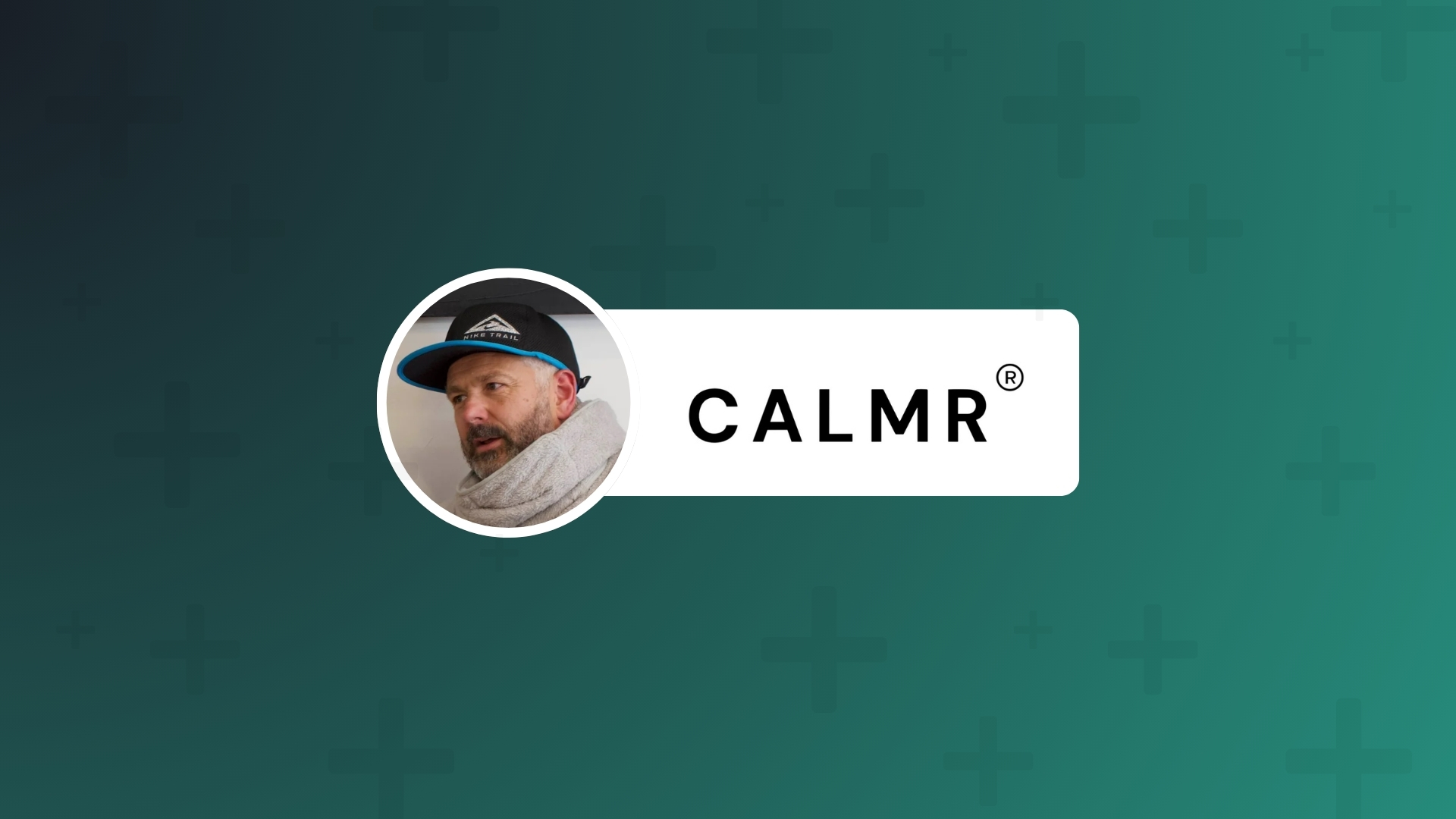
Matt Pattison is CALMR’s founder. He trained as an NHS physiotherapist before spending 20 years in design and human factors. The company came from his own experience of burnout and realising he needed to look after his nervous system, not just his cardiovascular system. We spoke about what he’s building and why sometimes innovation isn’t another piece of technology.
Can you introduce yourself and tell us about your role?
I’m Matt Pattison, founder of CALMR. I originally trained as an NHS physiotherapist before spending the last 20 years working in Design through human factors, design, research and innovation, helping some of the world’s biggest healthcare and technology companies understand people and create better products.
CALMR brings those worlds together. We design clothing and wearable products that use sensory input, including deep pressure, to help people regulate, reset and find a little more calm in an increasingly overstimulating world – we call this clothing that calms.
As founder, my role is a bit of everything – designer, researcher, storyteller, salesperson and occasionally chief box packer. But fundamentally, my job is to keep asking: how can we design things that help people feel different, not just look different?
How did your company come about and what was the motivation behind it?
CALMR came from my own experience of trying to find calm in the chaos.
I’d spent more than 20 years designing healthcare products and services for other people. I’m a Chartered Physiotherapist, Chartered Ergonomist and designer, so much of my career has been about understanding people, their bodies and how we can design better ways to support health.
The irony was that while relentlessly pursuing other people’s wellbeing, I was heading towards burnout myself. Working across the globe and winning design awards on one side of life. Not being able to effectively switch off on the other.
My traditional way of dealing with stress was exercise – including running away from Covid – but at the end of the Brighton Marathon with two slightly torn achilles I realised I had to look after my nervous system – not just my cardio vascular system.
I started exploring breathwork and Pilates, and that triggered a bit of a lightbulb moment. I remembered Deep Pressure Stimulation from my NHS days of working with SEN kids and began thinking about the calming, grounding sensation that pressure can provide.
Weighted blankets already existed, but I didn’t want another blanket. I wanted a hug I could take with me. Wearable calm.
That became the starting point for CALMR: wearable, tactile products designed to give the body a little help finding calm. No screen, no app, no notification telling you to relax. Just the power of touch.
What I created with a seamstress proved to be very powerful. I owed the world this.
So what started as solving a problem for myself grew into a bigger ambition: to create clothing that calms, and help make an increasingly chaotic world feel a little more manageable.
Can you describe your company’s mission and values?
Our mission is quite simple: to help people find calm in the chaos. Through clothing and accessories that help people to regulate their nervous systems, throughout the day ,and across context.
We live in a world that increasingly competes for our attention. More screens, more notifications, more noise, more expectation, more pressure – less calm. Yet many of the solutions we’re offered involve adding another thing to think about.
CALMR takes a different approach. We know you cannot out think your way out of stress alone. We start with the body. We design tactile, sensory products that can help people pause, regulate and feel more grounded – what we call Clothing that Calms. We let the body do the talking.
Our values come from that. We’re human first and science informed. We believe in designing with people rather than simply for them, particularly neurodivergent people whose sensory needs have historically been poorly considered in mainstream design. We are inspired by neurodiversity.
We also believe wellbeing products should be desirable. Something designed to support anxiety, stress or neurodiversity shouldn’t have to look clinical or label the person wearing it.
And finally, we believe in less digital, more human. Sometimes innovation isn’t another piece of technology. Sometimes it’s giving your nervous system something simple, physical and reassuring to respond to.
Ultimately, we want to help create a world where looking after your nervous system becomes as normal as looking after your physical fitness.
What are some of the most pressing social issues that your company is working to address through its technology?
One of the biggest issues we’re interested in is the growing mismatch between the world we’ve created and the nervous systems we were born with.
Modern life is extraordinarily stimulating. We’re constantly connected, interrupted and expected to perform. For neurodivergent people in particular, sensory overload and difficulties with regulation can make everyday environments – work, education, healthcare, travel or simply being in a busy public space – much harder to navigate.
Much of the response has been digital: another wellbeing app, another notification, another piece of content telling us how to feel better. CALMR is deliberately exploring the opposite direction.
Our technology is fundamentally human technology. We use principles from ergonomics, sensory science and Deep Pressure Stimulation to create wearable products that interact physically with the body.
We’re particularly interested in making sensory support more inclusive and less stigmatising. A neurodivergent adult shouldn’t necessarily have to wear something that looks medical or identifies them as different in order to access something that helps them regulate. We also set out to make products that look and feel luxurious and stylish, not just functional.
Ultimately, we’re exploring a simple question: what if the things we already wear could help us cope better with the world around us?
That takes CALMR beyond wellness. We see potential applications across neurodiversity, healthcare, education, workplaces, sport and other environments where helping people regulate could enable them to participate more fully.
How does your company measure the impact of its work in creating positive change?
We’re still a young company, so we’re developing how we measure impact as we grow. But I’m very conscious that impact can’t simply be a scoreboard of products sold or revenue generated.
At an individual level, we listen closely to the people using CALMR – their experiences, feedback and the situations in which our products help them regulate, feel calmer or participate more comfortably. As our research develops, we also want to build stronger evidence around physiological, behavioural and real-world outcomes.
But there’s a second measure that is becoming equally important to us: where CALMR enables people to participate.
Our recognition by IBCCES as a Certified Autism Resource is part of that journey. So too is the breadth of collaborations we’re building across workplaces, universities and education, healthcare, sport and public environments. Each partnership gives us another opportunity to understand what inclusion actually means in a different context – and potentially remove a barrier to participation.
So I’m increasingly interested in measuring not only the number of people we impact, but the number and breadth of environments in which we can make a difference.
There’s also a less tangible measure: influence. If our work helps organisations think differently about nervous-system regulation, the impact can extend far beyond the CALMR products they use.
In your opinion, what impact will technology have in creating a better future?
I’ve spent much of my career working with technology, and I’m hugely optimistic about what it can enable. AI in particular is going to give individuals and small organisations capabilities that would have been unimaginable even a few years ago.
I don’t think a better future comes simply from having more technology. It comes from designing technology around what human beings actually need.
Over the decades of products I have worked on, things break down due to the simplest of usability factors. So we wanted to make our technology simple, as simple to put on as a scarf.
Also, with my background is in human factors, and one of its fundamental principles is that understanding when people struggle with a system, we shouldn’t immediately ask what is wrong with the person. We should ask what we could change about the system.
I think that question is going to become increasingly important. As AI accelerates everything around us, human attention, cognition and nervous systems don’t suddenly accelerate with it. In fact, the gap may become greater.
So some of the most important innovation may actually be technology that helps us remain human in an increasingly technological world.
That’s partly why CALMR today is deliberately physical. There’s no battery and no screen. The technology is in the materials, ergonomics, sensory science and the way the product interacts with the body.
I think the best future will combine extraordinary digital capability with a much deeper understanding of human needs. Technology should adapt to humans, rather than continually asking humans to adapt to technology.
What advice do you have for other companies looking to use technology for good and create a positive impact in the world?
My advice would be: start with the human, not the technology.
There’s always a temptation to fall in love with what technology can do before asking whether anybody actually needs it.
Go and spend time with people. Watch them. Listen to them. Understand where life is difficult, frustrating, exclusionary or unnecessarily complicated. Then ask what you can change to help them.
And don’t assume technology has to mean digital. Sometimes the best solution might involve AI; sometimes it might be advanced materials.
I’d also encourage companies to think more broadly about impact. Of course measure revenue, growth and numbers reached – businesses need to survive to create change. But also look for the things that are harder to count: Did somebody participate who previously couldn’t? Did you change an organisation’s thinking? Did your idea influence somebody else to design something better?
Perhaps most importantly, stay curious. The biggest opportunities often appear when you stop trying to prove that your original idea was right and start listening to what people are actually telling you.
Technology for good shouldn’t be about putting more technology into the world. It should be about using our ability to innovate to leave the world a little better than we found it.
—
Sometimes the best solution is giving your nervous system something simple and physical to respond to.
You can find out more about CALMR by visiting www.calmrpeople.com