
This interview is part of the Impact Interview series, produced in partnership with Empact Ventures and the Alzheimer’s Society Innovation Programme. The series features founders building technology for positive impact across People, Health, and Planet.
Most dementia care happens in episodes: a clinic visit every few months, a diagnosis that often comes late, and very little support in between.
Punto Health is building AI-powered tools for continuous cognitive care, supporting people from the earliest signs of decline through to dementia. They’re working with NHS trusts across London, hospitals in Barcelona, and have reached more than 800 users.
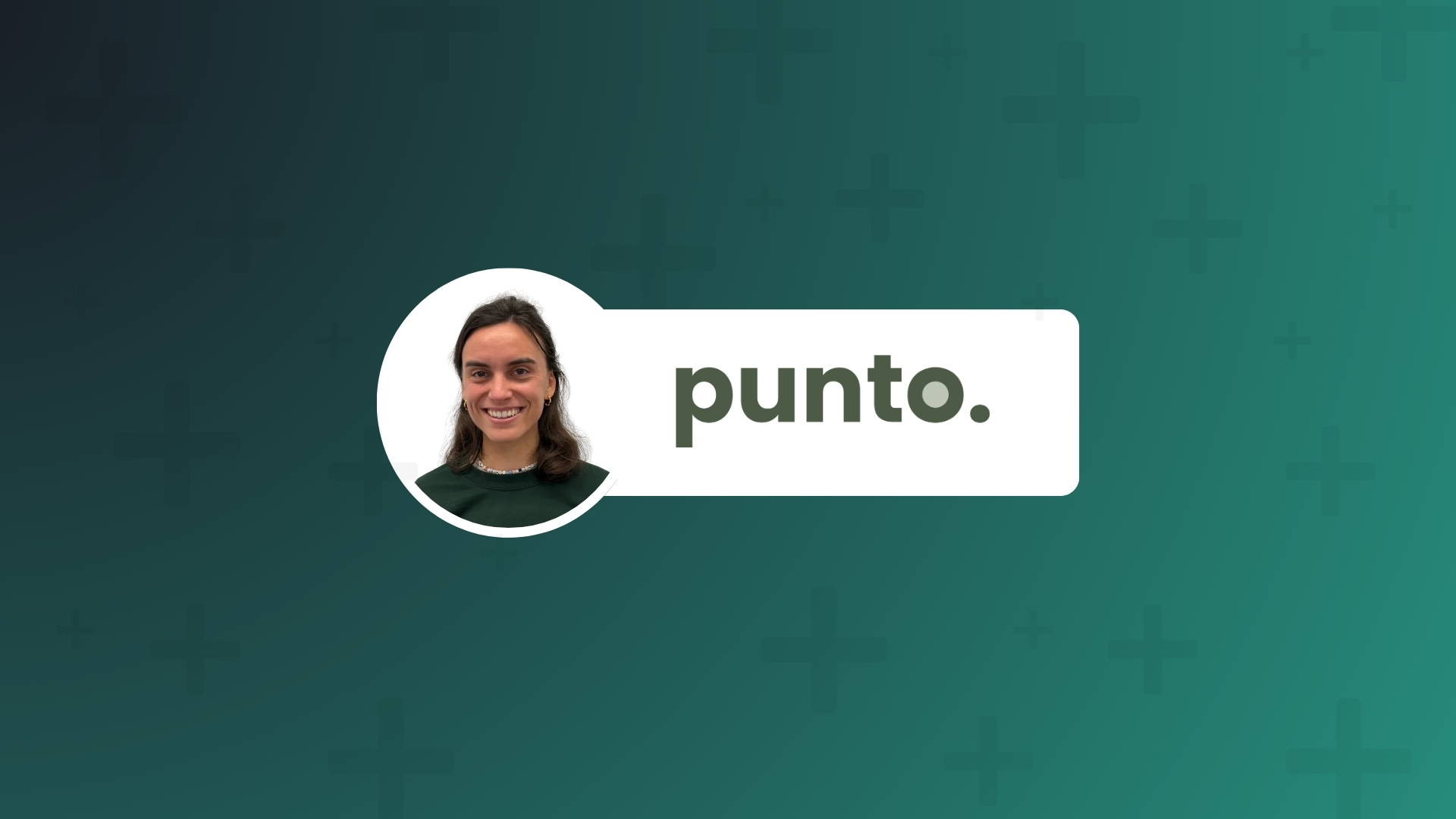
Anna Muñoz Farré is Punto’s Co-Founder and CEO. Her grandfather lived with Parkinson’s and Lewy body dementia for nearly 20 years. We spoke about what she’s building and why co-design isn’t optional.
Can you introduce yourself and tell us about your role?
I’m Anna Muñoz Farré, Co-Founder and CEO of Punto Health. We build an AI-powered platform for continuous cognitive care, supporting people from the earliest signs of cognitive decline all the way through dementia, alongside their families and clinical teams.
My background is in AI and engineering. I did research at MIT and UPC-Barcelona Tech, then worked at health and AI companies including Elvie and BenevolentAI, applying deep learning to real healthcare challenges. At Punto, my role covers everything from shaping our clinical partnerships with the NHS and Spanish public health systems to guiding product strategy and fundraising.
What drives me most is seeing the gap we’re closing. For too long, dementia care meant late diagnosis and very little support after that. Every time a clinician tells us PuntoCare changed how a patient’s family navigates a really hard situation, I’m reminded exactly why we built this.
How did your company come about and what was the motivation behind it?
Punto Health was born out of a personal experience. My grandfather lived with Parkinson’s and Lewy body dementia for nearly 20 years. I saw how hard it was for him as a patient, but also how it affected my grandma as his main carer. Ever since I thought something had to change, especially now that it’s my parents’ generation’s turn…
Three years ago I decided it was time, so I spent months speaking with clinicians, patients, carers, and families before thinking about what the product would look like. I saw how the whole system is completely broken. Everyone always thinks about the diagnosis as the biggest gap, but it’s also what happens after. Families were left without guidance. Clinicians had no visibility between appointments. Care was fragmented, generic, and exhausting for everyone involved.
We co-founded Punto at the end of 2023, and codesigned everything with clinicians, patients and carers from day one. Since then, we’ve grown to work with NHS trusts across London, leading hospitals in Barcelona, secured two NIHR research awards, and reached more than 800 users aged 55 to 91. The problem is enormous, but so is the opportunity to do better.
Can you describe your company’s mission and values?
Our mission is to bring evidence-based cognitive care into everyday life, making it continuous, personalised, and accessible for patients, families, and clinicians.
The values that shape how we work:
Clinical credibility first. We don’t ship anything that hasn’t been validated with real clinicians and real users. It’s slower, but it’s the only way to build something that belongs in a healthcare pathway.
Designed with, not for. Every feature in Punto has been co-designed with people living with cognitive decline, carers, and healthcare professionals. We involve users from initial concept through to ongoing iteration, not just as testers but as collaborators.
Accessibility is non-negotiable. Many of our users are not digitally native. We had to unlearn standard UX patterns and rebuild from scratch for this population. Simpler is often harder, but we hold the line.
Human-first technology. AI at Punto is invisible support. It personalises plans, surfaces insights, and reduces burden. It is never the hero. People are.
These values mean we sometimes grow more slowly than companies that prioritise reach over rigour. We think that’s exactly right for the space we’re in.
What are some of the most pressing social issues that your company is working to address through its technology?
The scale of the problem is striking. There are 78 million people living with dementia globally, and the annual cost of care is $2.8 trillion, with roughly half of that borne by informal carers, mostly family members, mostly women.
Yet dementia care remains deeply broken. Diagnosis is slow. Post-diagnostic support is generic at best, absent at worst. Sixty-five percent of patients lack personalised, consistent support after diagnosis. Seventy-two percent of carers report high levels of stress and anxiety. Two in three healthcare providers say they would like to prescribe digital tools but have no pathway to do so.
Punto addresses this across three interconnected problems:
Late detection. PuntoTest is a five-minute speech-based digital biomarker for cognitive assessment. It doesn’t require previous speech data to detect risk, making it scalable in primary care settings where most people first seek help.
Post-diagnostic abandonment. PuntoCare delivers personalised daily care plans (cognitive stimulation, physical activity, emotional support, symptom tracking) in an accessible, gamified format. We are currently in NHS feasibility studies across multiple memory services.
Clinical disconnection. PuntoClinic gives healthcare teams actionable longitudinal insights, reducing the fragmentation that leaves clinicians working blind between appointments.
Technology doesn’t replace care. But it can make good care continuous rather than episodic.
How does your company measure the impact of its work in creating positive change?
We measure impact across outputs, outcomes, and user experience, and we hold ourselves to clinical standards rather than product metrics alone.
Output metrics: More than 800 users aged 55 to 91 actively using PuntoCare. Over 95 million cognitive stimulation exercises completed. Average engagement of four days per week.
Outcome metrics: In a study with the neurology unit at Granollers General Hospital (n=107), 71.3% of users maintained adherence after one month, and 50% after six months, significantly above benchmarks for digital health tools in this population. One in two users reported feeling less stress and anxiety. One in three reported improvements in their daily physical condition.
Clinical validation: We collect data through formal pilots and NIHR-funded research studies. Our methodology involves clinicians at every stage, standardised outcome measures, and independent evaluation. Our first publication has been submitted to JMIR Neurotechnology and is under review.
Qualitative measures: Patient and carer testimonials, clinician feedback, and co-design sessions give us signal that numbers alone can’t capture. When a carer tells us they finally feel equipped, or a patient says they feel less afraid, that tells us something important that a spreadsheet never will.
We are also honest about what we don’t yet know. Longer-term outcomes and health system cost impacts are what our current NIHR studies are designed to answer.
In your opinion, what impact will technology have in creating a better future?
I’m genuinely optimistic, but carefully so. Technology has already changed what’s possible in cognitive health in ways that would have seemed implausible a decade ago. The idea that a five-minute speech test could indicate cognitive risk without needing a prior baseline is extraordinary, and it only exists because of advances in AI.
Looking ahead, three shifts matter most for our space:
AI personalisation at scale. No clinician can tailor a care plan for thirty patients simultaneously and adjust it weekly based on how each person is doing. AI can. That’s not replacing the clinician. It’s giving them leverage they simply don’t have today.
Continuous data over snapshot assessment. The standard model in dementia care is episodic: a clinic visit every few months. Digital tools can provide longitudinal, real-world data that makes those appointments far more valuable and catches deterioration before it becomes a crisis.
Accessibility for excluded populations. Too much health technology is designed for people who are already digitally confident. If we build differently, with older adults and people with cognitive challenges from the ground up, we can reach people who have historically been left behind by innovation.
The risk I’d flag honestly: technology designed without clinical rigour, or deployed without equity in mind, can widen the gaps it promises to close. The question is always whether we’re building with human flourishing as the goal, or just building because we can.
What advice do you have for other companies looking to use technology for good and create a positive impact in the world?
Co-design is not optional. The biggest trap in tech for good is building something for a community you haven’t genuinely listened to. Before we wrote a line of code, we spent months with patients, carers, and clinicians. That shaped everything. The people you’re trying to serve will tell you what actually matters, if you create real space for them to do so. Co-design isn’t a box to tick. It’s how you avoid building something nobody uses.
Clinical rigour is a competitive advantage, not a constraint. It’s tempting to move fast and validate later. In health, that approach erodes exactly the trust you need to reach the people who need you most. Our NHS partnerships and NIHR research studies took longer to secure, but they’ve opened doors that no amount of marketing could have. Healthcare providers and patients need evidence. Give them real evidence.
Design for the hardest user first. We had to completely rethink standard UX to build for older adults living with cognitive challenges. It was one of the most demanding and most rewarding parts of the journey. What we found is that designing for the most excluded user almost always produces something better for everyone. Simplicity, clarity, and calm are not niche requirements. They’re excellent designs.
The problem space around ageing and cognitive health is genuinely urgent, and there is so much still left to build. If you’re drawn to it, go in with humility, with rigour, and with the people you’re trying to help at the centre of everything.
—
Anna’s point about designing for the hardest user first is the one worth holding onto. Build forexc the most excluded user and you almost always end up with something better for everyone.
You can find out more about Punto Health at Puntohealth.com