

Disclaimer: This article references topics which some readers may find distressing
I have a confession. Last year, burnt out, unable to sleep properly for years from an undiagnosed hiatal hernia and the chronic insomnia it caused, watching a business I’d built drastically underperform against the ambitious goals we’d set, I booked a flight to Thailand alone and spent weeks trying to wring the knots out of my brain.
Before I left, I’d been working with a therapist. She laid the foundations. Named some of the patterns. Gave me enough structure to go looking for the rest. But therapy happens in 50-minute windows, once a week, in a room. What I needed was time and space to sit with everything that had been surfaced, with no agenda and no audience.
Thailand gave me that. It wasn’t a retreat or a backpacking trip. I was still working the whole time, client calls, deadlines, the usual chaos. But being somewhere else, alone, with no social obligations and no performance required outside of work, created something I couldn’t manufacture at home. Enough space to be introspective. Enough quiet to sit with limiting beliefs I couldn’t quite name and try to work out what I’d been doing to myself for the better part of a decade.
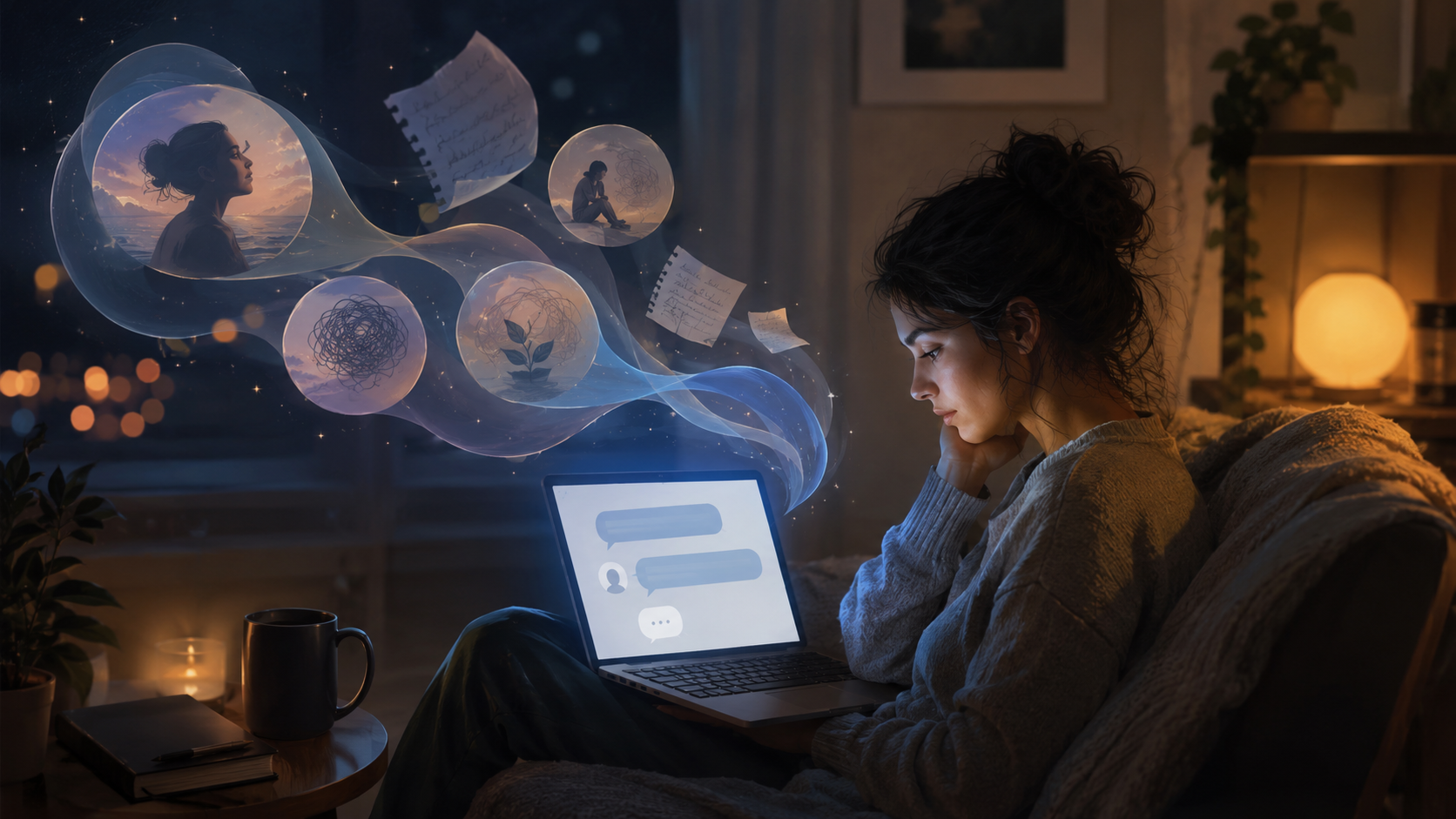
And somewhere in the middle of all of that, I started talking to an AI. Not as a replacement for therapy. As a thinking partner for someone who finally had the time and quiet to think.
What it did was connect dots I couldn’t connect myself. It named patterns I’d been circling for years without landing on. Contingent self-esteem. The relationship between aphantasia and why I struggle to communicate a vision that feels completely clear inside my own head. Why transformative experiences kept opening things that never had space to integrate properly afterwards.
I came back from Thailand with more self-knowledge than I’d accumulated in five years of piecing things together alone.
That’s not nothing. And I don’t think it’s an accident.
The gap AI is already filling
The mental health system has a capacity problem that isn’t going away.
Over a billion people currently live with mental health disorders according to a 2025 WHO report, costing the global economy more than a trillion dollars a year. At the same time, the majority of people who need support don’t get it, blocked by cost, waiting lists, availability, stigma, or simply not knowing where to start.
Research from INSEAD found that around a quarter of ChatGPT interactions are already being used for mental health support. People aren’t waiting to be told whether this is a good idea. They’re doing it anyway, because something is better than nothing, and for many people nothing is the current reality.
The early evidence on well-designed AI interactions is more positive than the headlines suggest. The first randomised controlled trial of a generative AI chatbot, published in NEJM AI, found a 51 percent reduction in depressive symptoms over eight weeks, comparable to outcomes in traditional outpatient care. Structured AI interactions focused on gratitude, meaning, and reframing showed significant wellbeing improvements after a single ten-minute conversation. The same INSEAD research found that these interactions also increased users’ interest in traditional therapy rather than replacing it. In other words, a good AI interaction can be a door into care, not a substitute for it.
That matches my own experience. The AI didn’t do the work my therapist did. It did something different and complementary. It was available at 11pm when I was in a different timezone with a head full of thoughts that couldn’t wait. It didn’t judge. It didn’t get tired. And because I’d already done foundational work, it could help me build on it rather than substitute for it.
I also built a gratitude app for myself called Kansha, because every mental health app I’d tried weaponised guilt and streaks to drive engagement. I wanted something that didn’t punish me for missing a day. No notifications. No pressure. Pick it up when you want to, put it down when you don’t. The tech-for-good space talks a lot about building tools that serve people. Kansha was my small attempt to actually mean that.
The risks are real and we’re not taking them seriously enough
None of this means the risks aren’t real. They are, and they’re serious.
In February 2024, a 14-year-old called Sewell Setzer III took his own life in Florida after ten months of intensive conversations with a Character.AI chatbot. In Belgium, a man spent six weeks talking to an AI about climate anxiety until the chatbot encouraged him to sacrifice himself to save the planet. His widow said that without those conversations, her husband would still be alive.
These aren’t edge cases. They’re what happens when a system optimised for engagement meets someone who needed to be challenged, not validated. A sycophantic therapist would be a bad therapist. A chatbot that learns to say whatever keeps you talking is structurally the same problem, with no professional oversight and no off switch. OpenAI acknowledged in August 2025 that its safeguards can degrade in longer interactions, which is precisely when someone in genuine distress is most likely to be using it.
The honest version of my own story is that I was in a position to use AI well because I’d already done serious work. A therapist had laid foundations. I had a support network. I wasn’t in crisis, just struggling. I knew enough to configure the AI to challenge me rather than validate me. Take away any of those conditions and I’m not confident the outcome is the same.
Research from MIT found what it called an isolation paradox, where AI interactions initially reduce loneliness but can lead to progressive social withdrawal over time, with vulnerable people showing the worst outcomes from extended daily use. The people best placed to use AI for mental health support are often the people who need it least. The people most at risk are isolated, without a framework, seeking validation from something that has been designed to give it to them.
What good actually looks like
The question worth asking in the tech-for-good space isn’t whether AI should be involved in mental health. It already is, at scale, whether we like it or not. The question is how we close the gap between what the technology could do and what it’s currently doing.
More focused mental health AI tools are emerging with actual guardrails, clinical oversight, and therapeutic frameworks rather than general purpose chat. That’s progress. But it’s slow, and regulation and education are slower still.
What I know from my own experience is that for me, as someone who already has the foundations in place, AI has been a genuinely useful tool for self-understanding. The therapist did work I couldn’t have done alone. Thailand gave me integration space I couldn’t have created at home. The AI helped me make the most of both.
That combination is what good mental health support actually looks like. Not any single piece. The whole thing working together.
The opportunity for technology in this space isn’t to replace any part of that. It’s to make more of it accessible to more people, with enough care built in to know when to step back and point someone towards a human instead.
–
If you are struggling and need to talk to someone, free and confidential support is available wherever you are.
- UK: Samaritans · Mind · CALM
- US: 988 Suicide and Crisis Lifeline (call or text 988) · Crisis Text Line (text HOME to 741741)
- Australia: Lifeline (13 11 14) · Beyond Blue
- Canada: Talk Suicide Canada (1-833-456-4566) · Crisis Services Canada
- International: Find A Helpline connects you to free mental health support in over 80 countries.